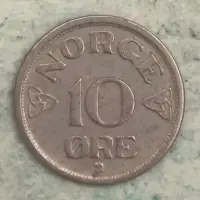
Obverse
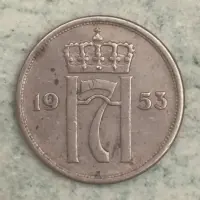
19 H7 53
At the centre, the crowned monogram of King Haakon VII (a large 'H' and a large '7' intertwined). The date, 1953, is divided on either side of the monogram (19 to the left and 53 to the right).
 Norway · 1953 · 10 øre
Issued as part of the post-war monetary series of King Haakon VII, an extremely popular monarch, especially for his heroic resistance during the German occupation of Norway (1940-1945). Symbol of resistance (H7) is much more than just a royal initial. During the occupation, it became a secret symbol of resistance and loyalty to the exiled king and a sign of defiance against the Nazi forces. The 10-øre coin of this series began to be struck in 1951 (or 1952 according to sources) and continued until 1957. The year 1953 marks the midpoint of this post-war series, testifying to the regained stability and the continued attachment to the monarchical symbol after the trials of the occupation.
At the centre, the crowned monogram of King Haakon VII (a large 'H' and a large '7' intertwined). The date, 1953, is divided on either side of the monogram (19 to the left and 53 to the right).
At the centre, the face value in large characters 10. At the top, the inscription NORGE (Norway). At the bottom, the monetary unit ØRE. Triskeles flank the number 10. At the very bottom, under the unit, one can see the mint mark of the Kongsberg mint (a crossed hammer).
Actual size compared with the 2 € and 1 € coins. Thickness: 1.2 mm.
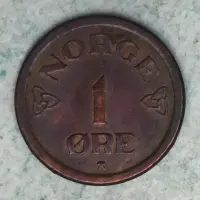 1 øre1957 · 16 mm
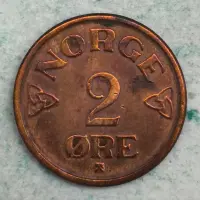 2 øre1954 · 21 mm
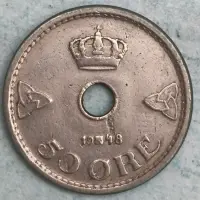 50 øre1948 · 22 mm
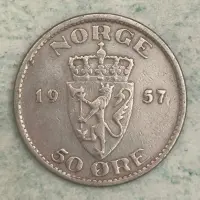 50 øre1957 · 22 mm
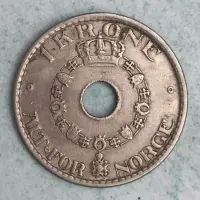 1 krone1950 · 25 mm
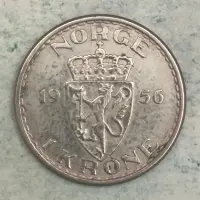 1 krone1956 · 25 mm
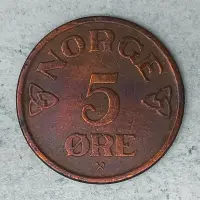 5 øre1955 · 27.1 mm