Obverse
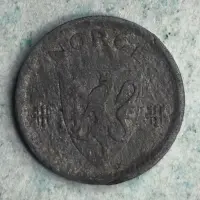
NORGE
The national coat of arms of Norway, the rampant lion holding an axe (axe of Saint Olaf), at the centre of a shield. Around the coat of arms, the circular legend indicates the name of the country, “NORGE”.
 Norway · 1942 · 10 øre
This 10-øre 1942 coin, struck in zinc, is a subsidiary coin of the Kingdom of Norway issued during World War II. Norway being under German occupation (1940-1945), the use of zinc (a less precious metal) symbolizes the management of resources during wartime, and the absence of the royal monogram of Haakon VII on the obverse reflects the political situation under occupation. The national lion remains present as a symbol of resistance and Norwegian identity despite the occupation.
The national coat of arms of Norway, the rampant lion holding an axe (axe of Saint Olaf), at the centre of a shield. Around the coat of arms, the circular legend indicates the name of the country, “NORGE”.
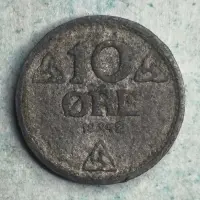
The number “10” is inscribed large at the top centre, with the word “ØRE” below. The date “1942” is placed under “ØRE”. Trilobed or stylized Celtic knot motifs are visible on either side of the value, and another at the bottom, under the date.
Actual size compared with the 2 € and 1 € coins. Thickness: 1.32 mm.
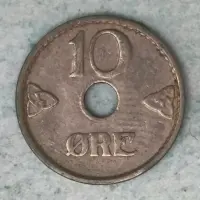 10 øre1938 · 15 mm
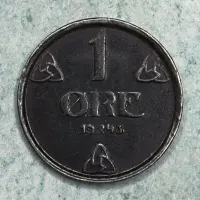 1 øre1943 · 16.1 mm
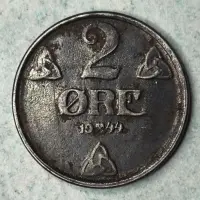 2 øre1944 · 21.15 mm
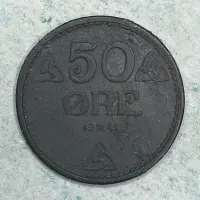 50 øre1941 · 22.3 mm
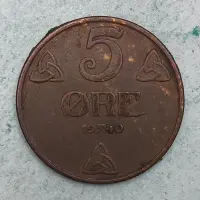 5 øre1940 · 27.15 mm
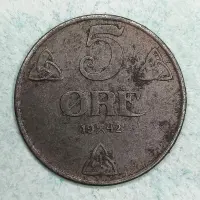 5 øre1942 · 27.21 mm